Casares has been inhabited for thousands of years by a myriad of
civilisations, each leaving its mark. Besides walking along the narrow,
cobbled streets with their Moorish design, one should not miss the
opportunity to see the Arab Castle at the top of the hill where the
views are spectacular.
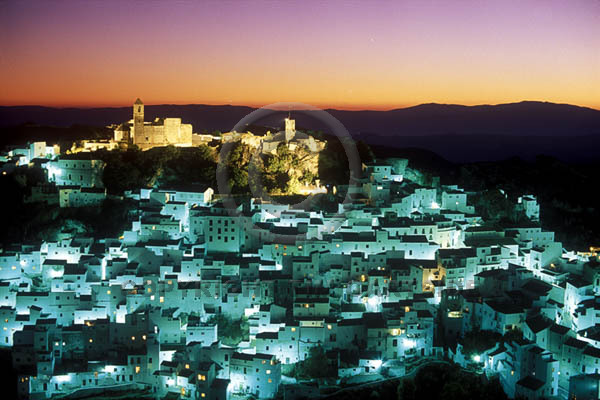
Casares is a picture postcard village with a population of just three
thousand and the view from the approach is definitely worth a photo. To
say that Casares is beautiful is an understatement. Most of the white
villages are beautiful but there is something very special about the
sight of Casares that causes the visitor to park the car and simply
stare or take a photo. There are the sugar cubes again, piled
precariously high and just nudging the battlements of the Arab castle.
It is hard to believe that this enchanting, typical village is only nine
miles from the hustle and bustle of the coast and somehow succeeded in
avoiding the coach tour circuit.
Locality:
The village of Casares is just 14 kilometres from the bustling and
cosmopolitan Costa Del Sol, in the province of Andalucia. Its municipal
territory stretches between the Costa del Sol, the Ronda highlands and
the Gibraltar plain. As a result, it shows some of the characteristics
of each of those three zones, although the mountain region more
influences its appearance than the other two.
Those wanting a rewarding scenic experience can follow the narrow
street adjacent to the Virgin del Rosario chapel. Keep climbing and
eventually you will have reached the top of the town of some 1,400 feet
above sea level.
There is an old fortress and a derelict church, as well as a
marvelous view overlooking the rooftops of the village. Peregrine
falcons and kestrels can be found here, on a clear day, you will be able
to spy on the African coast with the Rock of Gibraltar looming craggily
in the foreground. Tiny village shops full of local produce hide round
every corner with a scattering of small bars and cafes thrown in for
good measure. Local pottery and leatherwork are very good buys.
The town is almost untouched by tourism. Casares has its own little
museum with artefacts dating from the Roman times. The whole town is a
photographer’s paradise. In Roman times the town was of such importance
that it had its own mint and Roman baths which were ordered to be built
by Caesar as a sign of gratitude to being cured of a skin complaint
after bathing in the sulphurous waters in the locality. Numerous Roman
ruins lie close by, including part of an aquaduct. A truly, sleepy
village, locked in time. The local fiestas take place in the first two
weeks of August and the Cristo fair takes place in September when the
village comes alive.
Hiển thị các bài đăng có nhãn Rock of Gibraltar. Hiển thị tất cả bài đăng
Algeciras Travel Guide
5/15/2012
Algeciras is primarily and unashamedly a port and industrial centre, sprawling round the far side of the bay to Gibraltar.
It is an industrial city that supports the large deep water container port and nearby oil refinery. In the port area there are many Moroccans in transit, particularly during July and August when migrant workers return home for their holidays from their work in France, Holland and Belgium. As a consequence, there is a strong Arab influence here with many of the signs in Arabic as well as Spanish while, in the backstreets, you can find several traditional tea shops which specialise in the traditional Moroccan mint tea.
The port is the major departure point not only for cargo but also for ferries to N Africa, the Canary Islands and Barcelona. It developed quickly after the railway from Bobadilla was completed in 1890, becoming an important transportation hub for the region. It makes no concessions to foreign visitors and allows a rare glimpse of how the rest of coastal Spain used to be before the onset of charter flights and mass tourism.
Algeciras may not be a beautiful city but it does have a gritty individuality about it and, unlike some of the Costa resorts, is a very genuine place with a real port atmosphere. There are lots of reasonably priced restaurants to try – several with terrific views of the nearby Rock of Gibraltar.
Those that find the time to wander will fine quiet parks and tree lined plazas almost hidden away from the rushing travellers. For most people, however, Algeciras is just a stopping off place, en route to Tangier and Morocco. There are about eight crossings a day (2 hrs 30 mns or 70 minutes with a fast ferry).
Locality:
Situated on the W coast of Algeciras Bay, opposite Gibraltar, Algeciras occupies sloping ground backed by the Sierra de Luna Mountains to the W. Algeciras is on the S tip of Spain, at the extreme W end of the Costa del Sol. 9 mls N of Morocco across the Strait of Gibraltar. 90 mls SW of Malaga airport. 9 mls W of Gibraltar and its airport.
Algeciras is most popular among mature types wanting escape from the typical holiday-resort atmosphere and preferring authentic Spanish town life.
Also a much cheaper base from which to visit Gibraltar if staying on the “Rock” is too claustrophobic. Attractions here include strolling around the older parts of town, such as Plaza Alta and the “Barrio San Isidro”. A couple of historic 17th-century churches are also popular among tourists. Maria Cristina Park is also worth a visit.
By night there is a small selection of local bars, discos, bingo and cinemas (both in Spanish). The principal hotel provides a full entertainments programme day and night. In terms of beaches there are two sandy beaches liying at the W edge of the port, but Getares Beach, 2½ mls along the coast, is a more attractive proposition with a good stretch of fine sand.
Bars and the usual beach facilities are available here in summer only.
Local excursions here tend to revolve around trips to Gibraltar, Tangier; Jerez (including sherry bodegas); Ronda.
It is an industrial city that supports the large deep water container port and nearby oil refinery. In the port area there are many Moroccans in transit, particularly during July and August when migrant workers return home for their holidays from their work in France, Holland and Belgium. As a consequence, there is a strong Arab influence here with many of the signs in Arabic as well as Spanish while, in the backstreets, you can find several traditional tea shops which specialise in the traditional Moroccan mint tea.
The port is the major departure point not only for cargo but also for ferries to N Africa, the Canary Islands and Barcelona. It developed quickly after the railway from Bobadilla was completed in 1890, becoming an important transportation hub for the region. It makes no concessions to foreign visitors and allows a rare glimpse of how the rest of coastal Spain used to be before the onset of charter flights and mass tourism.
Algeciras may not be a beautiful city but it does have a gritty individuality about it and, unlike some of the Costa resorts, is a very genuine place with a real port atmosphere. There are lots of reasonably priced restaurants to try – several with terrific views of the nearby Rock of Gibraltar.
Those that find the time to wander will fine quiet parks and tree lined plazas almost hidden away from the rushing travellers. For most people, however, Algeciras is just a stopping off place, en route to Tangier and Morocco. There are about eight crossings a day (2 hrs 30 mns or 70 minutes with a fast ferry).
Locality:
Situated on the W coast of Algeciras Bay, opposite Gibraltar, Algeciras occupies sloping ground backed by the Sierra de Luna Mountains to the W. Algeciras is on the S tip of Spain, at the extreme W end of the Costa del Sol. 9 mls N of Morocco across the Strait of Gibraltar. 90 mls SW of Malaga airport. 9 mls W of Gibraltar and its airport.
Algeciras is most popular among mature types wanting escape from the typical holiday-resort atmosphere and preferring authentic Spanish town life.
Also a much cheaper base from which to visit Gibraltar if staying on the “Rock” is too claustrophobic. Attractions here include strolling around the older parts of town, such as Plaza Alta and the “Barrio San Isidro”. A couple of historic 17th-century churches are also popular among tourists. Maria Cristina Park is also worth a visit.
By night there is a small selection of local bars, discos, bingo and cinemas (both in Spanish). The principal hotel provides a full entertainments programme day and night. In terms of beaches there are two sandy beaches liying at the W edge of the port, but Getares Beach, 2½ mls along the coast, is a more attractive proposition with a good stretch of fine sand.
Bars and the usual beach facilities are available here in summer only.
Local excursions here tend to revolve around trips to Gibraltar, Tangier; Jerez (including sherry bodegas); Ronda.
Đăng ký:
Bài đăng (Atom)


